
NIRMAN
Non-Linear Initiative for Research & Meta-Construction Network
by Women
This program is equipping women with the skills and knowledge to work in the fast-evolving and essential field of green construction—an area critical for sustainable development and climate action. The trainees are learning to operate machines used to produce high-strength green concrete and various design mixes needed defense-quality infrastructure. The program aims for zero waste, repurposing all concrete waste as garden pots, furniture, paperweights, designer tiles,., adhering to the principles of reduce, reuse, restore, and go green.

When the concept was introduced, there were initial apprehensions, would women and their families be willing to participate in a 50 day long, semi-residential training program? Could women from rural backgrounds adapt to an intensive technical curriculum? Will they be able to leave behind their farming related work? Who will teach them and how? These doubts, however, have been unequivocally dispelled. The enthusiasm, commitment, and sheer talent displayed by the women trainees have exceeded all expectations.
Women-Friendly, Child-Friendly Learning Space
One of the most distinctive aspects of this program is its uniquely designed training environment. Understanding the social realities that women face, the training center has been structured to be welcoming and accommodating facilities, prioritizing safety, good healthcare, and a sense of belonging for every person in the factory.
Many women trainees are mothers, and they are provided with the support they need to balance learning with family responsibilities. The Learning Centre located within the factory ensures that no woman has to choose between her education and child-care. Therefore the training space is made child-friendly, welcoming and owning their kids, ensuring that mothers can fully engage in the program without anxiety. This has significantly contributed to their focus, motivation, and overall well-being.
Enthusiastic Learners
The biggest revelation of the program has been the exceptional curiosity and grasp of concepts displayed by the trainees. Women, many of whom have had limited access to education, are excelling in understanding eco-friendly building materials, energy-efficient designs, and sustainable construction methods.
Their ability to adapt, learn, and apply new skills is a proof of untapped potential that lies in rural women. As it was rightly said by Prime Minister Modi, soon the Self-Help Groups will turn into ‘Nation Help Groups’.

Universal Design for Learning
The biggest revelation of the program has been the exceptional curiosity and grasp of concepts displayed by the trainees. Women, many of whom have had limited access to education, are excelling in understanding eco-friendly building materials, energy-efficient designs, and sustainable construction methods.
Their ability to adapt, learn, and apply new skills is a proof of untapped potential that lies in rural women. As it was rightly said by Prime Minister Modi, soon the Self-Help Groups will turn into ‘Nation Help Groups’.
To ensure that technical knowledge is truly accessible, the training curriculum is being transected using a Universal Design for Learning (UDL) approach. A team of technical experts, language specialists, and social development scientists is working to break down complex concepts into easily understandable formats.
By using local languages, relatable domestic examples, illustrated visuals, and hands-on models, even the most challenging topics become engaging and comprehensible. Women are integrating
their learning into their cultural context—creating songs with newly acquired technical terms, singing them to the beats of the dholak and manjeera, reinforcing retention and revision.
For example, when a civil engineer explained the concept of high density through compaction and vibration—describing need to close air gaps between aggregate particles—one trainee explained to other peers this means “sans khatam karna”
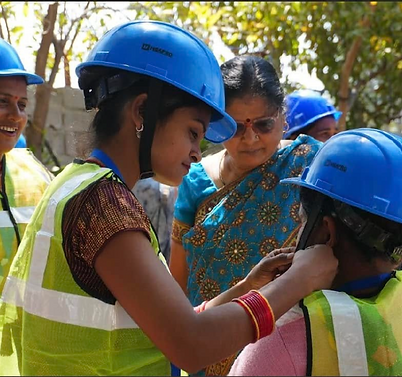
The aim was to create a feminine space for women where they can come, feel free, safe and learn with joy. Women share their experiences, domestic and health related issues in a non- judgmental and supportive environment. This has enormously improved their self-confidence. When women wore their industrial helmet and construction jacket for the first time, one of them said, ‘this has changed my mental status’. Many changed their WhatsApp profile pictures to their new professional look, proudly sharing their transformation. The sisterhood among them is palpable, and the training center in their words has become a ‘maika’ (mother’s home) for everyone—a place of support and belonging.
The programme is designed not just to provide skills or employment; it’s about breaking gender stereotypes, developing scientific temper to observe, organize and explore how and whys. The training sessions helps them ask questions and solve problems. Its is also about making them see that they are as competent in construction and technology as men, given recognition and a chance for education and capacity building.
The program prioritizes not only technical training but also well-being—offering healthcare, stress-free learning, and a deeply supportive environment. This ensures that women remain focused and motivated, knowing that their presence in the industry is valued and necessary. The 400 hour curriculum is built around the topics below, having gender as a cut across theme-
-
Raw material management and handling
-
Material testing
-
Batch-mix plant running
-
Forklift driving
-
Pal finger crane driving
-
Off-bearer machine handling
-
Machine operations-PLC control-general mechanics
-
Book-keeping
-
General management and waste management
-
Market need assessment
-
Understanding of profit and loss

A Model for Future Initiatives
The idea that rural women are hesitant or unwilling to engage in non-traditional professions is outdated, if we give them new roles the traditional self-defeating mindset start vanishing super fast and they quickly take to their new roles.
With the support of the Uttar Pradesh government, this initiative is setting a new benchmark for women’s participation in sustainable construction. It serves as a powerful model for future programs. These women are not just learning to build eco-friendly structural units; they are constructing a future where sustainability and gender equity go hand in hand.
The programme has perfected a revenue model that will help a group of 10-12 women earn about 15 thousand per month, per head, per production unit. Also, helping them earn carbon credits.
